Expert guide to wire rope splicing techniques, custom lifting beam fabrication, and industrial rigging systems in Pakistan. Learn ASME B30 standards and how Alsons Hardware delivers certified fabrication services.

In Pakistan's industrial landscape — from the bustling ports of Karachi to the oil fields of Balochistan — wire rope and custom-fabricated lifting equipment are the unsung heroes that keep operations moving. A properly spliced wire rope or a well-engineered lifting beam can mean the difference between a smooth lift and a catastrophic failure.
At Alsons Hardware, we've been providing custom metal fabrication and wire rope splicing services to Pakistan's industries for over 50 years. This guide covers everything you need to know about wire rope splicing techniques, custom lifting beam design, and why professional fabrication matters for your operation's safety and efficiency.
Why Custom Fabrication Matters for Pakistan's Industries
Every industrial facility in Pakistan faces unique challenges. Standard off-the-shelf lifting equipment doesn't always fit the bill — especially when you're dealing with:
- **Unusual load dimensions** — Oversized machinery, irregular components, or awkward-shaped cargo
- **Space constraints** — Low headroom, narrow aisles, or confined lifting zones
- **Specialized applications** — Marine environments, high-temperature areas, or corrosive conditions
- **Cost optimization** — Custom solutions that do exactly what you need without paying for unnecessary features
That's where Alsons Hardware's industrial steel fabrication expertise comes in. We don't just sell equipment — we engineer solutions tailored to your specific lifting challenges.
Wire Rope Splicing: The Complete Guide
Wire rope splicing is the process of creating a permanent loop (eye) or joining two wire rope ends together. Unlike mechanical fittings (clips, sleeves), a properly executed splice retains up to 90-95% of the rope's original breaking strength — far superior to the 80% typical of clip-based terminations.
When to Use Spliced Wire Rope
Spliced wire rope is the preferred choice for:
- **Critical lifting applications** — Where failure would cause injury or major damage
- **High-cycle operations** — Splices withstand repeated loading better than mechanical fittings
- **Sheave and drum systems** — Splices pass smoothly over pulleys without catching
- **Marine and offshore** — Spliced eyes are more corrosion-resistant than exposed clip ends
- **Rigging slings** — Industry standard for high-quality lifting slings
Wire Rope Splicing Techniques
There are several wire rope splicing techniques, each suited to different applications:
1. Hand Splicing (Traditional Method)
The oldest and most reliable method, where individual strands are untwisted and woven back into the rope body.
- **Strength retention:** 90-95% of original breaking strength
- **Best for:** Heavy-duty rigging, marine applications, permanent installations
- **Skill level:** Requires experienced splicers (Alsons Hardware employs certified splicers with decades of experience)
2. Mechanical Splicing (Swaged Fittings)
Uses hydraulic presses to compress metal sleeves over the wire rope, creating a secure termination.
- **Strength retention:** 95-100% of original breaking strength
- **Best for:** High-volume production, consistent quality requirements
- **Skill level:** Requires proper tooling and calibrated equipment
3. Flemish Eye Splice
A hybrid method where strands are mechanically separated and then swaged, combining hand splice reliability with mechanical consistency.
- **Strength retention:** 95%+ of original breaking strength
- **Best for:** Critical lifting slings, overhead crane applications
- **Skill level:** Requires specialized equipment and training
ASME B30 Wire Rope Inspection Requirements
ASME B30.9 (Slings) and B30.10 (Hooks) define inspection requirements for wire rope and spliced terminations. At Alsons Hardware, we follow these standards rigorously:
Daily/Pre-Use Inspection (Operator Level):
- Visual check for broken wires, kinks, or crushing damage
- Inspect splice area for strand displacement or corrosion
- Verify identification tags are legible
- Check for heat damage or weld spatter
Periodic Inspection (Certified Inspector — Monthly to Annual):
- Measure rope diameter at multiple points (wear reduces breaking strength)
- Count broken wires per lay length (removal criteria: 10 broken wires in one lay, or 5 in one strand)
- Inspect splice tail length and security
- Check for corrosion, pitting, or chemical damage
- Document findings in inspection log
Removal Criteria (Per ASME B30.9):
Wire rope must be removed from service if any of the following are found:
- 10 or more randomly distributed broken wires in one rope lay
- 5 or more broken wires in one strand of one rope lay
- Excessive wear (diameter reduction >10% of nominal)
- Severe corrosion or pitting
- Heat damage (discoloration, annealing)
- Kinks, birdcaging, or other structural damage
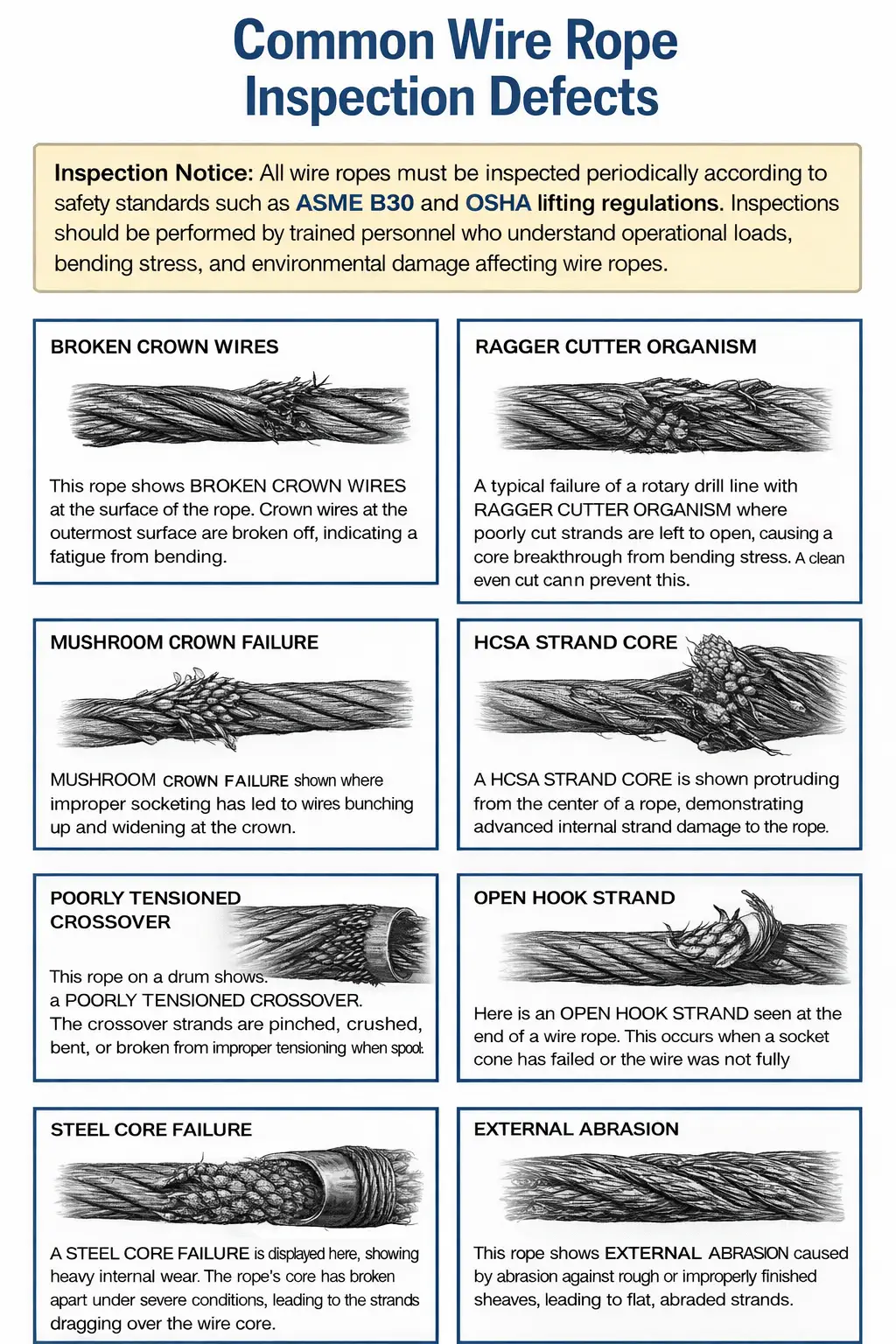
Common wire rope damage patterns that require immediate removal from service. Regular inspection prevents catastrophic failures.
Custom Lifting Beam Fabrication: Design to Installation
Lifting beams and spreader bars are essential for handling loads that can't be lifted safely with standard slings. Alsons Hardware designs and fabricates custom lifting beams for facilities across Pakistan — from steel mills in Port Qasim to textile manufacturers in Faisalabad.
Custom Lifting Beam Design Process
Step 1: Load Analysis
Our engineering team starts by understanding your lifting requirements:
- Load weight and center of gravity
- Load dimensions and lift points
- Required headroom and clearance
- Lifting frequency and duty cycle
- Environmental conditions (indoor, outdoor, corrosive, etc.)
Step 2: Engineering Design
We design lifting beams to meet or exceed ASME B30.20 (Below-the-Hook Lifting Devices) standards:
- **Design factor:** Minimum 3:1 safety factor on yield strength
- **Deflection limits:** Span/660 for normal service, span/888 for severe service
- **Load testing:** 125% of rated capacity before delivery
- **Documentation:** Complete design calculations, drawings, and test certificates
Step 3: Material Selection
Choosing the right steel grade is critical for lifting beam performance. The wrong material choice can lead to premature failure, excessive deflection, or dangerous over-engineering that makes the beam unnecessarily heavy and expensive.
Steel Grades for Lifting Beams:
- **ASTM A36 (Mild Steel)** — 36 ksi (250 MPa) yield strength. This is the most common and economical choice for general-purpose lifting beams used indoors. Easy to weld and machine, but heavier for a given capacity. Best for: Workshop cranes, maintenance facilities, light industrial use.
- **ASTM A572 Grade 50 (High-Strength Low-Alloy)** — 50 ksi (345 MPa) yield strength. Our recommended choice for most industrial applications in Pakistan. Offers 40% more strength than A36 with similar weldability. Best for: Heavy-duty outdoor applications, port facilities, steel mills, and high-cycle operations.
- **ASTM A514 (Quenched & Tempered Alloy)** — 100 ksi (690 MPa) yield strength. Premium high-strength steel for weight-critical designs where reducing beam weight matters. Requires pre-heating before welding and specialized procedures. Best for: Mobile crane beams, aerospace applications, situations where every kilogram counts.
- **Stainless Steel 316** — 30 ksi (205 MPa) yield strength. Essential for corrosive environments where carbon steel would rust prematurely. Marine applications, chemical plants, food processing facilities, and coastal installations in Karachi require stainless to prevent corrosion-related failures.
**Our Engineering Approach:** At Alsons Hardware, we select materials based on your specific environment, duty cycle, and load requirements — not just what's cheapest. For most Pakistan industrial facilities, we recommend ASTM A572 Gr. 50 as it offers the best balance of strength, durability, and cost-effectiveness in our climate.
Step 4: Fabrication and Welding
Alsons Hardware's welding and fabrication services follow AWS D1.1 (Structural Welding Code) standards:
- All welders are AWS-certified for structural steel
- Weld procedures qualified per ASME Section IX
- 100% visual inspection of critical welds
- Magnetic particle or dye penetrant testing on request
Step 5: Load Testing and Certification
Every lifting beam we fabricate undergoes rigorous load testing:
- **Static test:** 125% of rated capacity held for 10 minutes
- **Dimensional check:** Verify no permanent deformation after test
- **Weld inspection:** Post-test visual and NDT examination
- **Certification:** ASME-compliant test certificate with serial number traceability
Structural Steel Fabrication for Lifting Equipment
Beyond lifting beams, Alsons Hardware provides comprehensive structural steel fabrication for a wide range of industrial lifting applications:
Custom Rigging Equipment Fabrication:
- Spreader beams for oversized loads
- Lifting frames and cages
- Vacuum lifting systems
- Coil grabs and C-hooks for steel coils
- Sheet lifters for plate and coil handling
Heavy Duty Steel Fabrication:
- Crane runway beams and supports
- Load-bearing steel structures for gantry systems
- Custom hoist mounting frames
- Jib crane pedestals and wall brackets
Precision Metal Fabrication:
- Machined components for lifting devices
- Tolerance-critical assemblies (±0.5mm)
- Hardened wear plates and inserts
- Custom shackles, links, and rigging hardware
Lifting Beam Fabrication Standards: What You Need to Know
If you're sourcing custom lifting equipment in Pakistan, understanding the applicable standards helps you specify quality and verify compliance:
ASME B30.20 — Below-the-Hook Lifting Devices
The primary standard for lifting beam design and fabrication. Key requirements:
- Design by qualified engineer
- Minimum 3:1 design factor on yield
- Rated load marking on device
- Initial load test at 125% capacity
- Periodic inspection (annual minimum)
ASME BTH-1 — Design of Below-the-Hook Lifting Devices
Provides detailed design formulas and methodologies:
- Stress analysis requirements
- Deflection criteria
- Fatigue design for high-cycle applications
- Material selection guidelines
CMAA Specification 70/74 — Overhead Cranes
Relevant for lifting beams used with overhead cranes:
- Duty cycle classifications
- Load combination factors
- Dynamic load allowances
OSHA 1910.179 / 1926.551
US occupational safety standards often referenced in Pakistan for multinational projects:
- Inspection requirements
- Load testing frequencies
- Operator training mandates
Industrial Rigging Systems: Complete Solutions from Alsons Hardware
Beyond individual components, Alsons Hardware designs and supplies complete industrial rigging systems for Pakistan's most demanding applications:
Port and Marine Rigging:
- Container spreaders and lifting frames
- Ship-to-shore crane rigging
- Mooring line splicing and installation
- Offshore platform lifting equipment
Steel Mill and Foundry Rigging:
- Ladle lifting beams (high-temperature rated)
- Coil handling equipment
- Scrap box lifters
- Mold handling systems
Oil & Gas Rigging:
- Pipe handling beams (multiple lift point configurations)
- Valve lifting frames
- Christmas tree installation equipment
- Subsea lifting systems (corrosion-resistant)
Warehouse and Logistics:
- Pallet lifting frames
- Drum handlers
- Roll cage lifters
- Custom spreader bars for irregular loads
The Alsons Hardware Advantage for Custom Fabrication
With over five decades of industrial fabrication experience in Karachi, Alsons Hardware has become Pakistan's go-to partner for custom lifting equipment and wire rope services. Here's why:
In-House Engineering Expertise
Our team includes qualified mechanical engineers with specialization in lifting equipment design. We don't outsource engineering — every calculation is done in-house, ensuring accountability and rapid turnaround.
Certified Welding and Fabrication Facility
Our Karachi workshop is equipped for heavy duty steel fabrication:
- CNC plasma cutting (up to 50mm plate)
- Press brake forming (up to 6m length)
- Submerged arc welding for thick sections
- MIG/TIG welding for precision work
- Heat treatment capability for stress relieving
Wire Rope Splicing Specialists
We employ certified wire rope splicers with decades of hands-on experience:
- Hand splicing up to 50mm diameter wire rope
- Mechanical splicing with calibrated hydraulic equipment
- Full range of rigging equipment fabrication
- On-site splicing services for large installations
Quality Assurance and Documentation
Every custom fabrication project includes:
- Design calculations signed by qualified engineer
- Material certificates (mill test reports)
- Weld inspection records
- Load test certificates
- Operation and maintenance manuals
Fast Turnaround for Pakistan's Industries
We understand downtime costs money. Our production scheduling prioritizes urgent requirements:
- Standard lifting beams: 2-3 weeks
- Complex custom fabrications: 4-6 weeks
- Emergency repairs: 24-48 hour turnaround
- Wire rope splicing: Same-day service available
Wire Rope and Lifting Equipment Maintenance
Proper maintenance extends the service life of your wire rope and lifting equipment significantly:
Wire Rope Maintenance:
- **Lubrication:** Apply wire rope lubricant every 3-6 months (more frequently in corrosive environments)
- **Storage:** Keep spare rope coiled and protected from moisture
- **Handling:** Use rope reels or payoff stands to prevent kinking during installation
- **Inspection:** Document findings and track wear trends over time
Lifting Beam Maintenance:
- **Annual inspection:** Certified inspector per ASME B30.20
- **Paint touch-up:** Prevent corrosion on painted surfaces
- **Bolt tightening:** Check all fasteners quarterly (torque to specification)
- **Wear monitoring:** Measure pad and hook contact surfaces annually
Alsons Hardware offers scheduled maintenance contracts that include regular inspections, lubrication, and priority repair service.
Case Study: Custom Lifting Solution for Karachi Steel Mill
**Challenge:** A major steel mill in Port Qasim needed to lift 25-ton steel coils with varying widths (800mm to 1800mm). Standard C-hooks couldn't accommodate the full range safely.
Alsons Solution:
- Designed a variable-width coil grab with hydraulic adjustment
- Fabricated from ASTM A572 Gr. 50 steel with hardened wear inserts
- Integrated load cells for weight verification
- Load tested to 31.25 tons (125% of rated capacity)
Result:
- Single device replaced four different C-hooks
- Reduced rigging changeover time by 70%
- Eliminated safety incidents from improper hook selection
- ROI achieved in 8 months through efficiency gains
This is the kind of problem-solving engineering that Alsons Hardware brings to every custom fabrication project in Pakistan.
Get Started with Your Custom Fabrication Project
Ready to discuss your wire rope splicing or custom lifting equipment needs? The team at Alsons Hardware is here to help.
Our process:
1. **Initial consultation** — Discuss your application, load requirements, and constraints
2. **Site visit (if needed)** — Our engineer surveys your facility and takes measurements
3. **Design proposal** — Detailed quotation with drawings, specifications, and timeline
4. **Engineering approval** — Finalize design and obtain any required permits
5. **Fabrication** — Skilled craftsmen build your equipment to exact specifications
6. **Load testing** — Full ASME-compliant testing with certification
7. **Delivery and training** — Installation support and operator briefing
Contact Alsons Hardware today for a free consultation on your wire rope splicing or custom lifting equipment project in Karachi. With over 50 years of industrial fabrication expertise, we're Pakistan's trusted partner for lifting equipment engineering, steel fabrication, and rigging solutions.
Frequently Asked Questions
How long does a wire rope splice last?
A properly executed splice can last the entire service life of the wire rope — typically 3-7 years depending on application severity. Regular inspection per ASME B30 standards is essential to identify wear before it becomes critical.
What's the minimum wire rope diameter you can splice?
We can hand-splice wire rope from 6mm diameter up to 50mm. For smaller diameters (3-6mm), mechanical swaging is typically more practical and cost-effective.
Do you provide on-site wire rope splicing in Pakistan?
Yes, Alsons Hardware offers mobile splicing services across Karachi and surrounding industrial areas. We can splice wire rope on-site for cranes, elevators, and marine applications where removing the rope is impractical.
Can you fabricate lifting beams for explosive environments?
Absolutely. We fabricate lifting equipment with spark-resistant materials (bronze, stainless steel, or aluminum-bronze) for use in petrochemical plants, gas facilities, and other hazardous locations.
What certifications do your lifting beams come with?
Every lifting beam includes: design calculation certificate, material test reports, weld inspection records, load test certificate (125% capacity), and ASME B30.20 compliance documentation. All documents are traceable to the device serial number.
How quickly can you fabricate a custom lifting beam?
Standard designs take 2-3 weeks from approval to delivery. Complex fabrications may take 4-6 weeks. For urgent requirements, we offer expedited service with 7-10 day turnaround (subject to engineering review and production capacity).